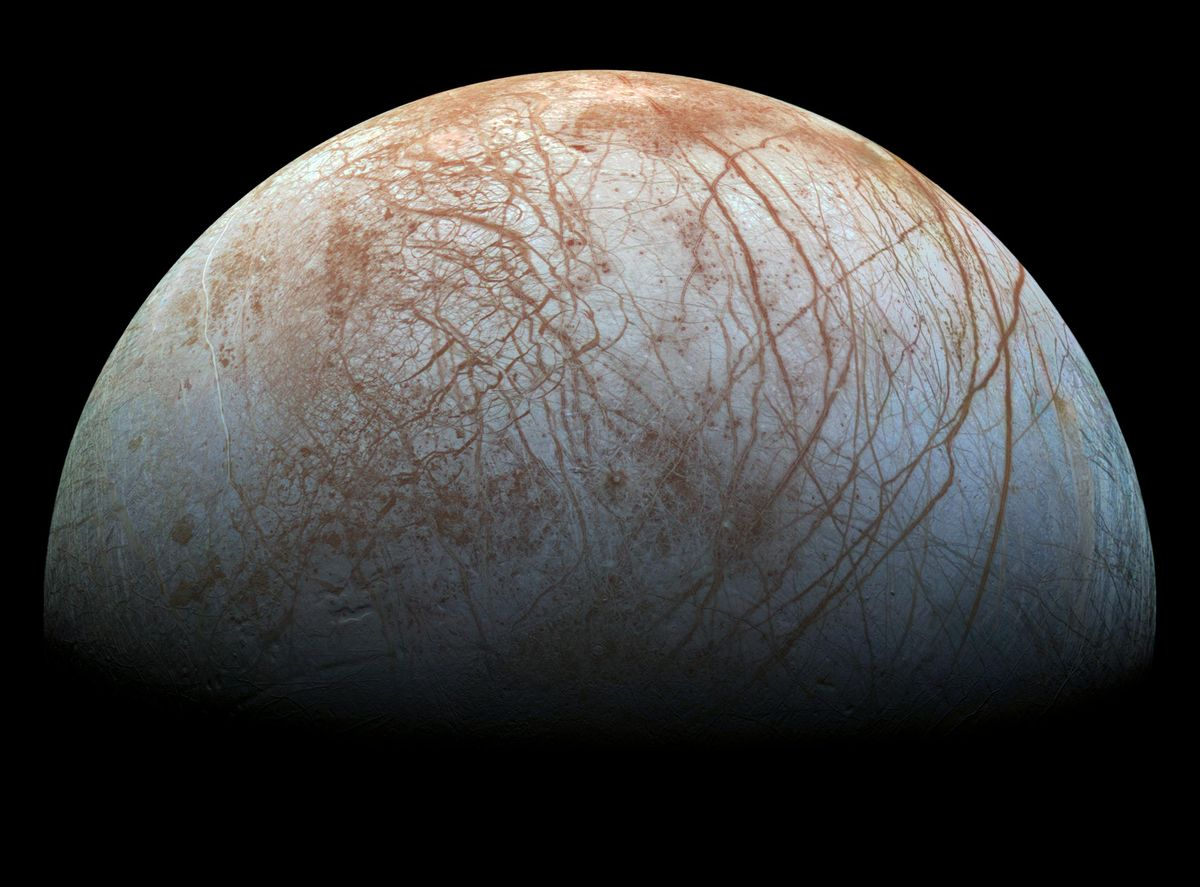
Among the many celestial bodies in our solar system, Europa — one of Jupiter’s largest moons — has emerged as a prime candidate for extraterrestrial life. Beneath its thick crust of ice lies a vast, global ocean estimated to contain twice as much water as all of Earth’s oceans combined. Scientists believe that this subsurface sea, kept warm by tidal heating from Jupiter’s immense gravity, could host the chemical ingredients necessary for life. Upcoming missions like NASA’s Europa Clipper, set to launch soon, aim to study the moon’s surface and plumes to detect organic molecules and determine whether this hidden ocean is habitable.
Europa’s intrigue lies in its combination of geological activity and potential for chemical energy — the two critical factors that sustain ecosystems on Earth’s ocean floors. Unlike Mars, which has become the focal point of surface exploration, Europa represents a different kind of promise: life that thrives in darkness, under kilometers of ice, independent of sunlight. Researchers use advanced spectroscopy and ice-penetrating radar to map these frozen layers, while laboratory simulations on Earth help understand how life could survive in such extreme conditions.
From an E-E-A-T (Experience, Expertise, Authoritativeness, and Trustworthiness) standpoint, the study of Europa exemplifies scientific credibility. The data-driven approach, peer-reviewed research, and transparent mission goals reflect the best of modern planetary science. As we continue to push the boundaries of space exploration, Europa reminds us that life might not be confined to planets with blue skies and green forests — it might thrive quietly in the cold, alien oceans beneath an icy shell millions of miles away.