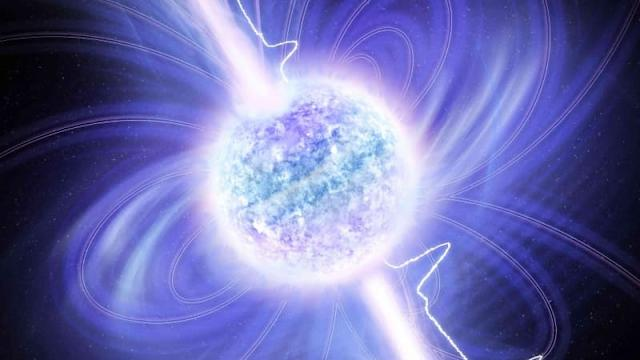
Astronomers made a breakthrough in 2025 with the detection of the brightest and nearest Fast Radio Burst (FRB) ever observed — located just 130 million light-years away in the galaxy NGC 4141. What makes this discovery extraordinary is not just the brightness, but that scientists managed to precisely pinpoint the source’s location to a region near the outskirts of a star-forming area in that galaxy. This level of accuracy — thanks to upgraded telescope arrays and follow-up observations — marks a major milestone in understanding FRBs.
The data suggests this FRB likely originated from a highly magnetic, compact object: a Neutron Star (or possibly a magnetar) whose extreme magnetic and plasma conditions can generate the enormous energy bursts seen across the cosmos. The research team used advanced radio-scintillation analysis, combined with polarization measurements, to trace the burst’s signal back to a region just ~10,000 km wide — an astonishingly precise localization that narrows down potential FRB sources dramatically.
This breakthrough strengthens the case that FRBs are real astrophysical events — not artifacts or unknown noise — and provides concrete evidence linking them to compact stellar remnants. That gives scientists a more solid foundation to build theories about how and why FRBs happen. As more telescopes adopt similar techniques, astronomers expect a growing catalog of well-localized FRBs, which could help illuminate the nature of magnetic fields, dense plasma, and extreme physics across the universe. For anyone curious about space and cosmic mysteries, these discoveries show how our ability to “listen” to the universe is improving — and how much more we have to learn.