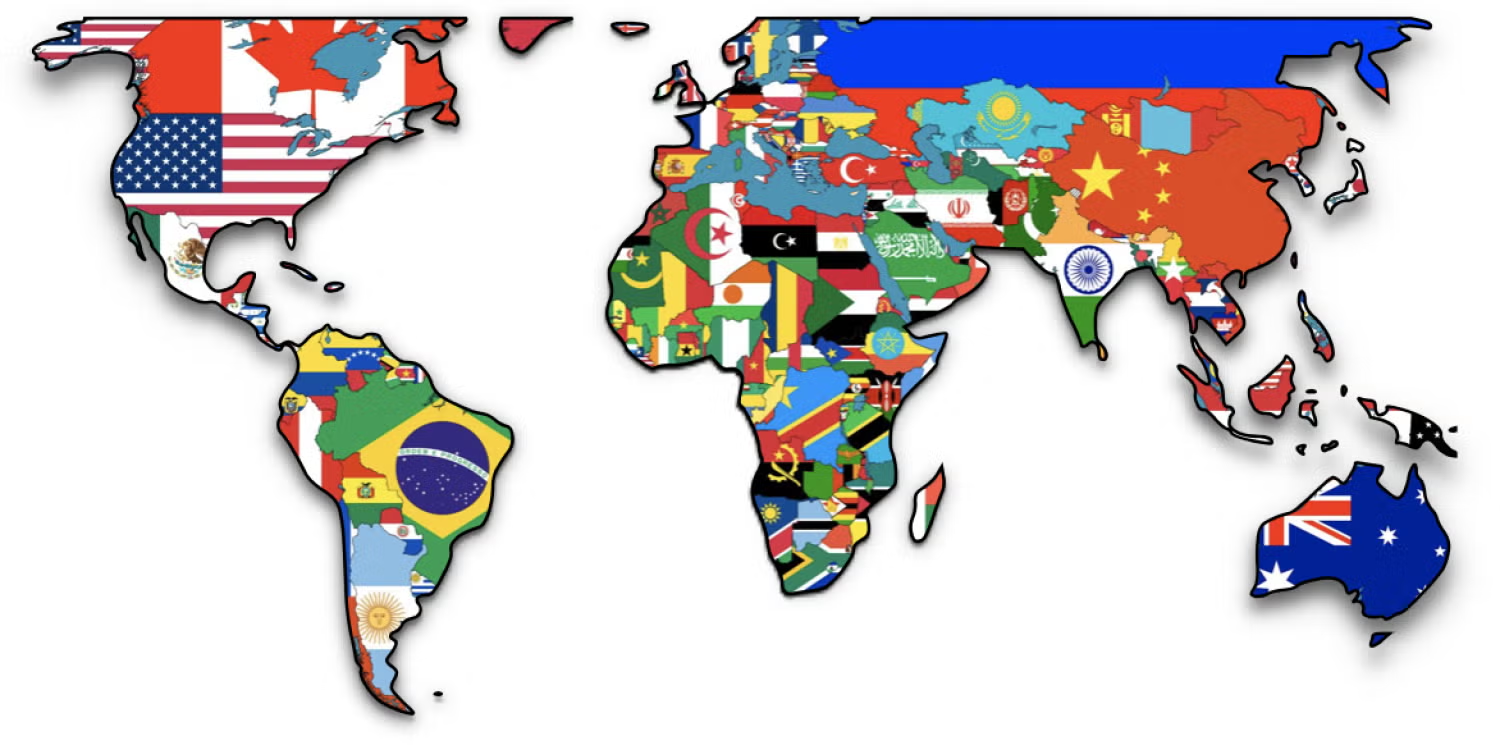
solsticeuniversity.com – Political geography is a subfield of human geography that examines the spatial dimensions of politics and the political dimensions of space. It explores how political processes shape the organization of territory, how spatial structures influence political outcomes, and the ways power is distributed, contested, and exercised across scales—from local neighborhoods to global geopolitics.
At its core, political geography investigates the interplay between politics (power, governance, identity, and conflict) and geography (location, territory, boundaries, scale, and environment). It goes beyond simply describing political maps to analyze why borders exist where they do, how states assert control over space, and how spatial inequalities affect political life.
Historical Development
Political geography has deep roots in the late 19th and early 20th centuries, when scholars sought to explain global power dynamics through geographical lenses.
- Friedrich Ratzel (Germany, 1897) introduced the concept of Lebensraum (“living space”) in his book Politische Geographie. He viewed states as organic entities that needed territory to grow and survive, drawing on Social Darwinism. This idea later influenced German geopolitics and, controversially, Nazi expansionist ideology.
- Halford Mackinder (UK, 1904) proposed the Heartland Theory in “The Geographical Pivot of History.” He argued that control of the Eurasian “Heartland” (roughly Eastern Europe to Central Asia) was key to world domination, famously stating: “Who rules East Europe commands the Heartland; who rules the Heartland commands the World-Island; who rules the World-Island commands the world.”
- Nicholas Spykman (US, 1940s) countered with the Rimland Theory, emphasizing the coastal “Rimland” (Europe’s fringes, Middle East, East Asia) as more strategically vital than the interior Heartland—ideas that influenced Cold War containment policies and NATO’s formation.
These classical theories focused on environmental determinism, state power, and grand strategy, but they were heavily criticized after World War II for justifying imperialism and aggression. By the mid-20th century, political geography shifted toward more critical approaches.
Key Concepts in Modern Political Geography
Contemporary political geography draws from diverse theoretical perspectives, including Marxism, feminism, postcolonialism, and post-structuralism. Core concepts include:
- Territory and Territoriality Territory is not just land—it is a socially constructed space over which power is exercised. Territoriality involves strategies to control space (e.g., borders, checkpoints, zoning). Modern examples include disputed territories like the South China Sea or Israel’s West Bank settlements.
- The State and Sovereignty The state remains central, but political geographers examine its spatial unevenness, sovereignty claims (e.g., Taiwan, Kosovo), and challenges from globalization, supranational bodies (EU, UN), and non-state actors (multinational corporations, terrorist groups).
- Geopolitics The study of how geography influences international relations and power struggles. Critical geopolitics treats geopolitics as discourse—narratives like “rogue states,” “axis of evil,” or “clash of civilizations” shape policy and justify actions.
- Borders and Boundaries Borders are lines of power, identity, and exclusion. They can be physical (walls, rivers) or symbolic (cultural, digital). Debates over migration, Brexit, or U.S.–Mexico border walls highlight their contested nature.
- Scale Politics operates at multiple scales: local (urban governance), national (elections), regional (trade blocs), and global (climate agreements). Power often “jumps scales” — local protests can influence international policy.
- Nationalism, Identity, and Citizenship How nations are imagined and constructed spatially (e.g., maps in textbooks, national monuments). Feminist and postcolonial approaches critique patriarchal or Eurocentric views of space and identity.
- Electoral Geography The spatial patterns of voting, gerrymandering, and how place influences political behavior.
- Political Ecology and Environment How political decisions shape environmental outcomes (e.g., resource conflicts, climate justice, deforestation in the Amazon).
Contemporary Relevance and Examples
Political geography helps explain many current global issues:
- The Russia–Ukraine conflict involves competing claims over territory, identity, and historical “heartland” logic.
- Climate change creates new geopolitical tensions over Arctic resources and migration routes.
- The rise of populism often ties to place-based grievances (rural vs. urban divides).
- Digital spaces and cyber-geopolitics challenge traditional territorial notions.
Today, political geographers use GIS mapping, qualitative methods, discourse analysis, and ethnography to study these dynamics. The field critiques state-centrism and highlights marginalized voices, power asymmetries, and resistance movements.
In summary, political geography reveals that space is never neutral—it is produced, contested, and imbued with power. Understanding it is essential for grasping why the world map looks the way it does and how political futures will unfold in an interconnected, multipolar era.