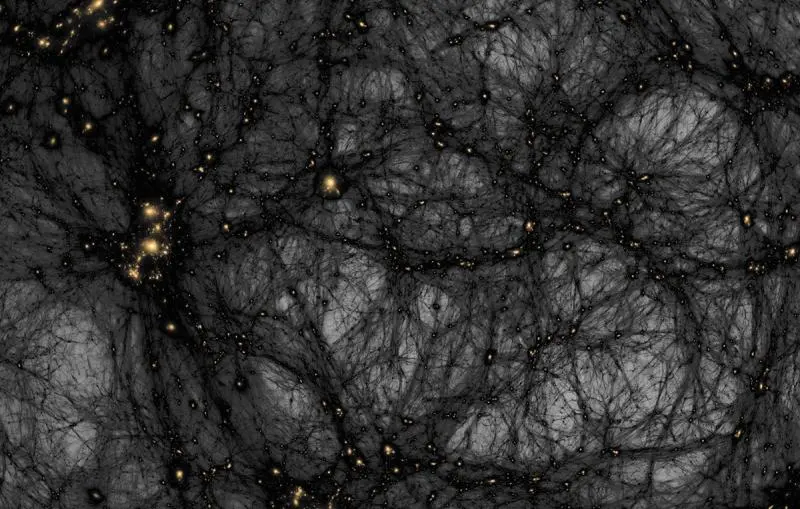
solsticeuniversity.com – Dark matter is one of the greatest mysteries in modern cosmology and physics. It is a form of matter that does not interact with light or electromagnetic radiation, making it invisible to telescopes and detectors that rely on light. Yet, its existence is inferred from gravitational effects on visible matter, galaxies, and the large-scale structure of the universe. Dark matter is estimated to make up about 27% of the universe’s mass-energy content, compared to just 5% for ordinary (baryonic) matter and 68% for dark energy. First proposed in the 1930s, dark matter remains undetected directly, but its influence is undeniable in explaining how galaxies form and rotate. As of 2025, ongoing experiments and observations continue to hunt for its true nature.
Evidence for Dark Matter
The concept of dark matter emerged from observations that visible matter alone cannot account for the universe’s behavior:
- Galaxy Rotation Curves In the 1970s, astronomer Vera Rubin showed that stars in the outer regions of galaxies rotate at speeds similar to those closer to the center. This defies Newtonian gravity unless there’s additional unseen mass providing extra gravitational pull.
- Gravitational Lensing Massive objects bend light from distant sources. Clusters like the Bullet Cluster show lensing effects far stronger than visible mass can explain, with “dark” mass separated from hot gas during collisions.
- Cosmic Microwave Background (CMB) Data from Planck satellite reveals fluctuations in the early universe that match predictions only if dark matter was present shortly after the Big Bang.
- Large-Scale Structure Galaxies form webs and voids on scales explained by dark matter’s gravity seeding structure formation.
These lines of evidence converge on cold dark matter (CDM) as the leading model—slow-moving particles that clump easily.
What Could Dark Matter Be?
No single particle has been confirmed, but candidates include:
- WIMPs (Weakly Interacting Massive Particles): Hypothetical particles interacting via weak force; long the favorite but elusive in detectors like LUX-ZEPLIN.
- Axions: Light particles proposed to solve QCD problems; searched in experiments like ADMX.
- Sterile Neutrinos: Non-interacting neutrinos.
- Primordial Black Holes: Tiny black holes from the early universe.
- Modified Gravity Theories (e.g., MOND): Alternatives suggesting gravity behaves differently on large scales—no dark matter needed.
Direct detection (underground labs), indirect (gamma rays from annihilation), and collider production (LHC) have yielded no definitive signals as of 2025.
Current Research and Experiments in 2025
Major efforts:
- LUX-ZEPLIN (LZ) and XENONnT: Deep underground detectors hunting WIMP collisions.
- Fermi Telescope and CTA: Looking for annihilation signals.
- Euclid Space Telescope: Mapping dark matter distribution via lensing.
- Future: Multi-messenger astronomy combining gravitational waves and light.
Challenges persist: If dark matter is very light or interacts weakly, detection may require next-generation tech.
Implications of Dark Matter
Dark matter explains why galaxies hold together, why the universe expanded as it did, and the formation of structures. Without it, the standard cosmological model (ΛCDM) collapses.
It also drives quests for physics beyond the Standard Model, potentially linking to dark energy or quantum gravity.
Why Dark Matter Matters
Dark matter reminds us how much we still don’t know—95% of the universe is “dark.” Solving it could revolutionize physics, energy, or even philosophy about reality.
As of 2025, the hunt continues with hope for breakthroughs from upgraded detectors or new telescopes. Dark matter may be invisible, but its gravitational fingerprint shapes everything we see—a cosmic puzzle waiting to be solved.